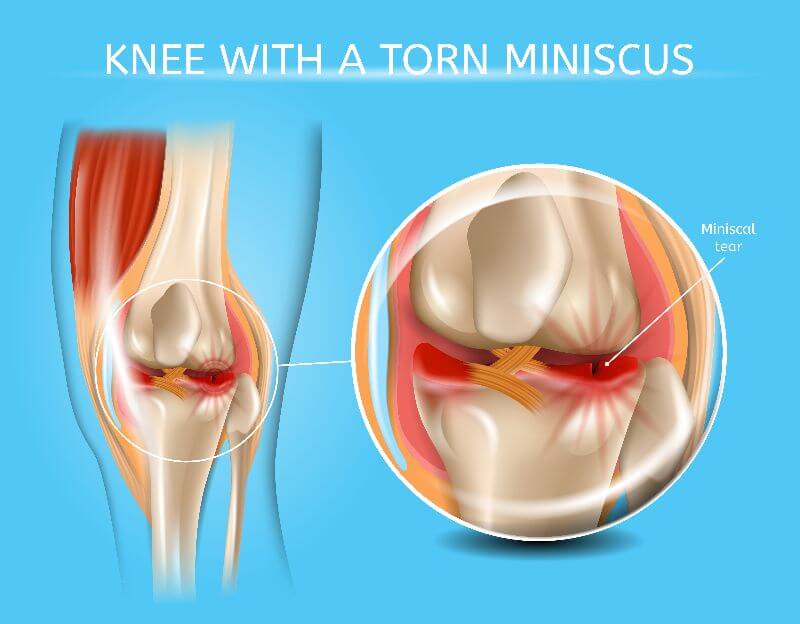
A meniscus tear is a cartilage injury of the knee that can be quite painful and debilitating. Although a meniscus tear is especially common in athletes, anyone can experience such an injury.
At OrthoMed Center, our board-certified orthopedic surgeons have extensive experience in treating a meniscus tear. They, along with our compassionate staff, are here to help if you experience a torn meniscus.
The meniscus is a C-shaped wedge of cartilage that lies between the thighbone (femur) and the shinbone (tibia) in the knee joint, acting as a shock absorber.
The knee joint has two menisci, one in the knee’s inner (medial) side and one in the knee’s outer (lateral) side. A tear in either meniscus is often referred to as “torn cartilage.” Tears in the medial (inner) meniscus are more common than tears in the lateral (outer) meniscus.
A combined loading and twisting injury to the knee is the most common cause of a sudden (acute) meniscus tear in younger people. In older people, a degenerative meniscus tear can occur without any significant injury to the knee.
A meniscus tear can also occur when a person injures one of the main supporting ligaments of the knee, which causes the knee to become unstable and increases the risk of a meniscus tear.
When a meniscus is injured, the knee often becomes painful and/or swollen. The pain from a torn meniscus can be quite debilitating and usually gets worse with certain movements, such as bending or twisting the knee. Some knee maneuvers may also produce a “click,” “pop,” or sharp pain at the medial or lateral joint line, which is the space between the thighbone and the shinbone.
If the torn piece of meniscus is large, it may cause the knee to catch, lock, or give way. Catching occurs when the torn meniscus fragment gets caught between the bones briefly before working its way out. If the fragment cannot work its way out, the knee will remain “locked” and will not fully bend or straighten. Locking can be brief (lasting seconds or minutes) or persistent (lasting weeks). Giving way occurs when the torn piece of meniscus slips out of place, which causes pain and reflex relaxation of the thigh muscles. When the muscles relax, the knee “gives way” or “gives out.”
Your orthopedic surgeon will conduct a physical exam and order imaging tests to rule out other potential knee injuries during your consultation. While x-rays cannot detect a meniscal tear, they are useful to rule out knee osteoarthritis, loose pieces of bone, a broken bone, or conditions that may mimic meniscus tear symptoms. In some cases, an MRI (magnetic resonance imaging) may be ordered to confirm diagnosis.
At OrthoMed Center, our orthopedic surgeons offer both nonsurgical and surgical treatment options for a meniscus tear.
A small meniscus tear that occurs on the outer edge of the meniscus may not require surgical treatment to heal, as this area has a rich blood supply that helps promote healing. Nonsurgical treatment of meniscus injuries may include:
- Activity modification
- Ice
- Medication to reduce pain and/or swelling
- Physical therapy
Surgical repair of a torn meniscus may be necessary if nonsurgical treatment fails to relieve pain and swelling or intermittent catching persists.
Surgery for a meniscus tear can be approached in a few different ways. In some cases, the surgeon performs a simple meniscectomy in which he trims away damaged meniscus tissue. The main objective is to preserve as much meniscus volume as possible to preserve knee health. In other cases, meniscus repair involves suturing the meniscus back together.
Knee arthroscopy allows your surgeon to perform these procedures without the need for large incisions. During an arthroscopy, a small camera (arthroscope) is inserted through one small incision, allowing your surgeon to review the inside of the knee on a monitor. Surgical instruments are inserted through additional small incisions to complete the meniscus repair. These small incisions provide for quicker recovery times and less pain after surgery.
Patients can return home the same day after surgery. Medications may be given to help with any pain or discomfort during recovery.
Physical therapy is an integral part of the recovery process to help improve mobility and strength in the knee.
Most patients can resume all normal activities once they have fully recovered. Full recovery times can vary based on the type of procedure. Patients who had a meniscectomy often recover within 3 to 4 weeks. Patients who had a meniscus repair will have a longer recovery time, typically about 3 months, to allow the meniscus to heal fully.
At OrthoMed Center, our orthopedic surgeons have extensive experience treating a meniscus tear. If you would like to set up a consultation with one of our surgeons, please call
(209) 524-4438 or
request an appointment online.